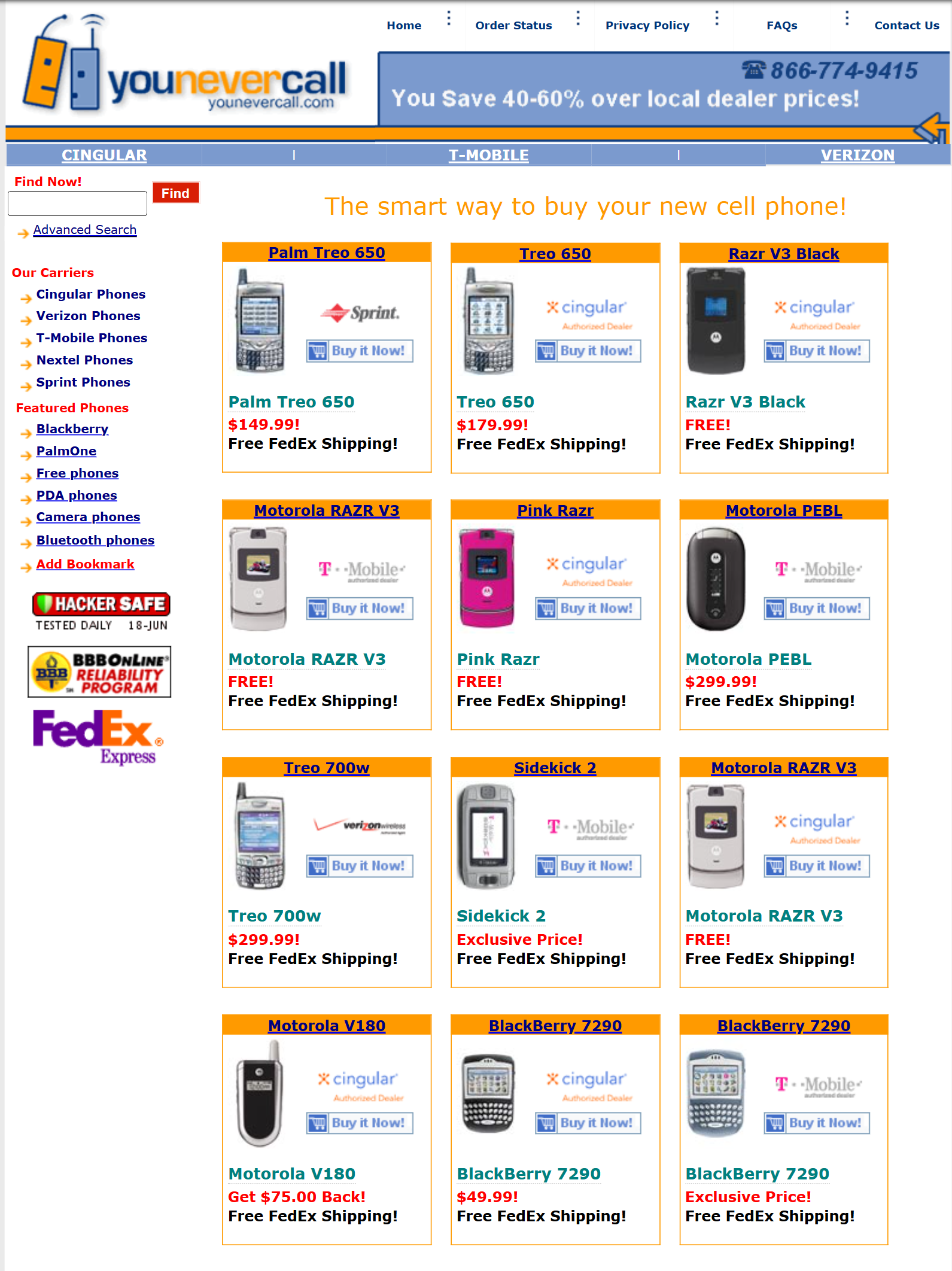
Before there was Five Blocks, there was YouNeverCall. It was an online cell phone store, and it is how I got into the reputation business in the first place. I never took the website down. YouNeverCall.com is still up, frozen in time with deals on the HTC EVO and the Droid Razr. I keep it running for nostalgia.
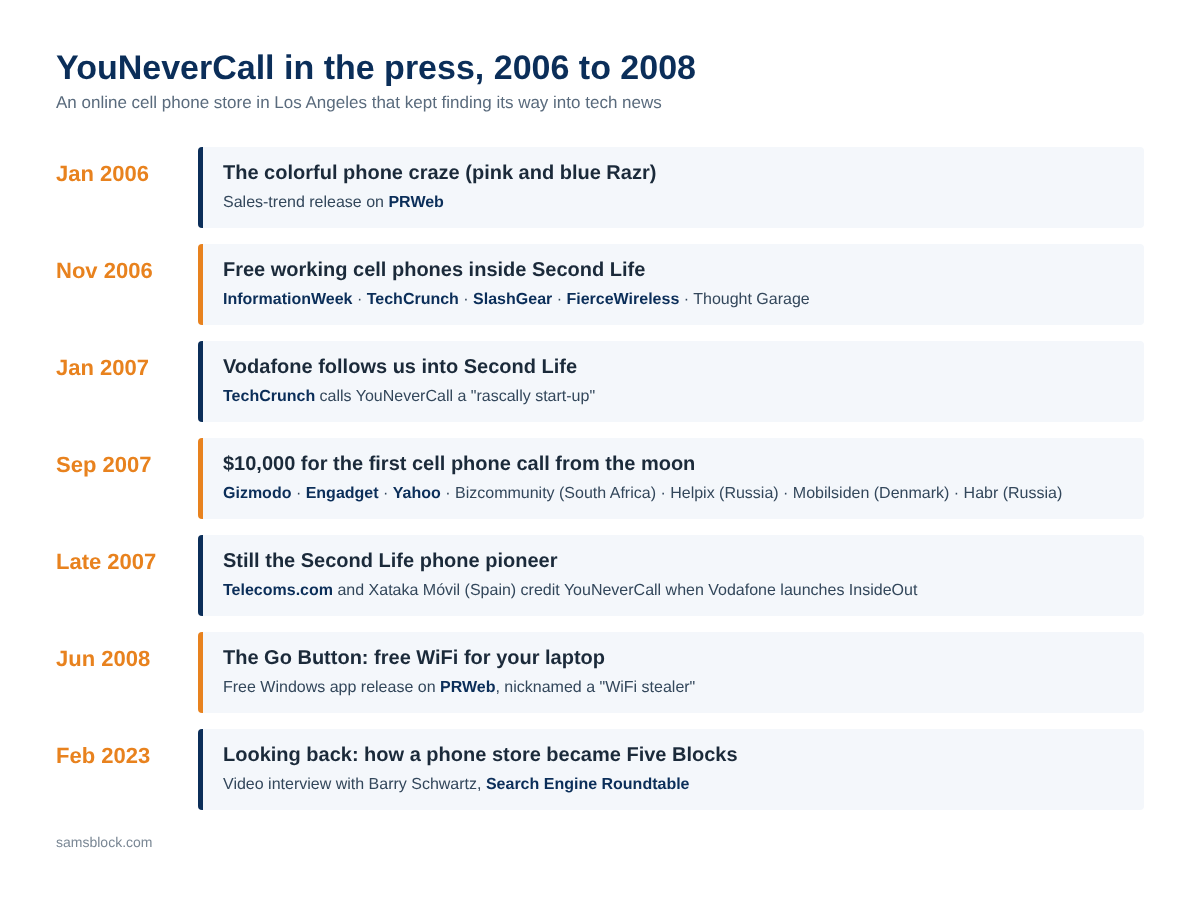
I recently went digging for everything I could find about those years: the press releases, the coverage, and the stunts. Here it is in one place.
A phone store with no marketing budget
YouNeverCall sold cell phones online as an affiliate. Many phones were free with a new T-Mobile, Verizon or Sprint plan, and we shipped by FedEx for free. The homepage asked a simple question: why buy your cell phone at the mall? I officially launched the company while spending a few months in Los Angeles, which is why our first address was in LA.
We had an ad budget, but all of it went toward driving sales. There was no marketing budget. So we got attention with stunts and press releases. Lots of them, and some of them pretty silly. My title on those releases changed depending on the day. On one I was CEO, on the next I was VP of Marketing. That is startup life.
2006: The pink Razr
One of the first was a January 2006 release on PRWeb about phone colors. Motorola had just put out the pink and blue Razr, and our sales numbers showed people were picking phones by color as much as by features.
2006: Free cell phones in Second Life
In November 2006 everyone was talking about Second Life, the virtual world where people bought land and clothes with Linden dollars. We gave its residents free virtual cell phones. They rang like real phones, could send and receive text messages, and needed no download. Our pitch was that they were more than just a fun accessory.
InformationWeek wrote it up. FierceWireless asked whether this was a new market for handset designers. TechCrunch picked it up from SlashGear and had some fun with it, guessing the phones were Razr knockoffs and telling users to “Get a life, a real one.” A blog called Thought Garage pointed out that 1.5 million virtual people could now get a cell phone too.
Then in January 2007, Vodafone announced it would sell its own phones inside Second Life. TechCrunch’s write-up said Vodafone was not going to be outdone by “some rascally start-up called YouNeverCall.” Being called a rascally start-up by TechCrunch while Vodafone follows you into a market is a pretty good day.
When Vodafone launched its InsideOut calling service later in 2007, Telecoms.com and Spain’s Xataka Móvil both noted that YouNeverCall had been there first. FierceWireless Europe called our phones the only rival voice service in Second Life.
2006: The time we were almost subpoenaed in a lawsuit against Samsung
YouNeverCall was not our only store. We also ran a few satellite sites, including AmericanCell.com (archived site) and mPhone.net.
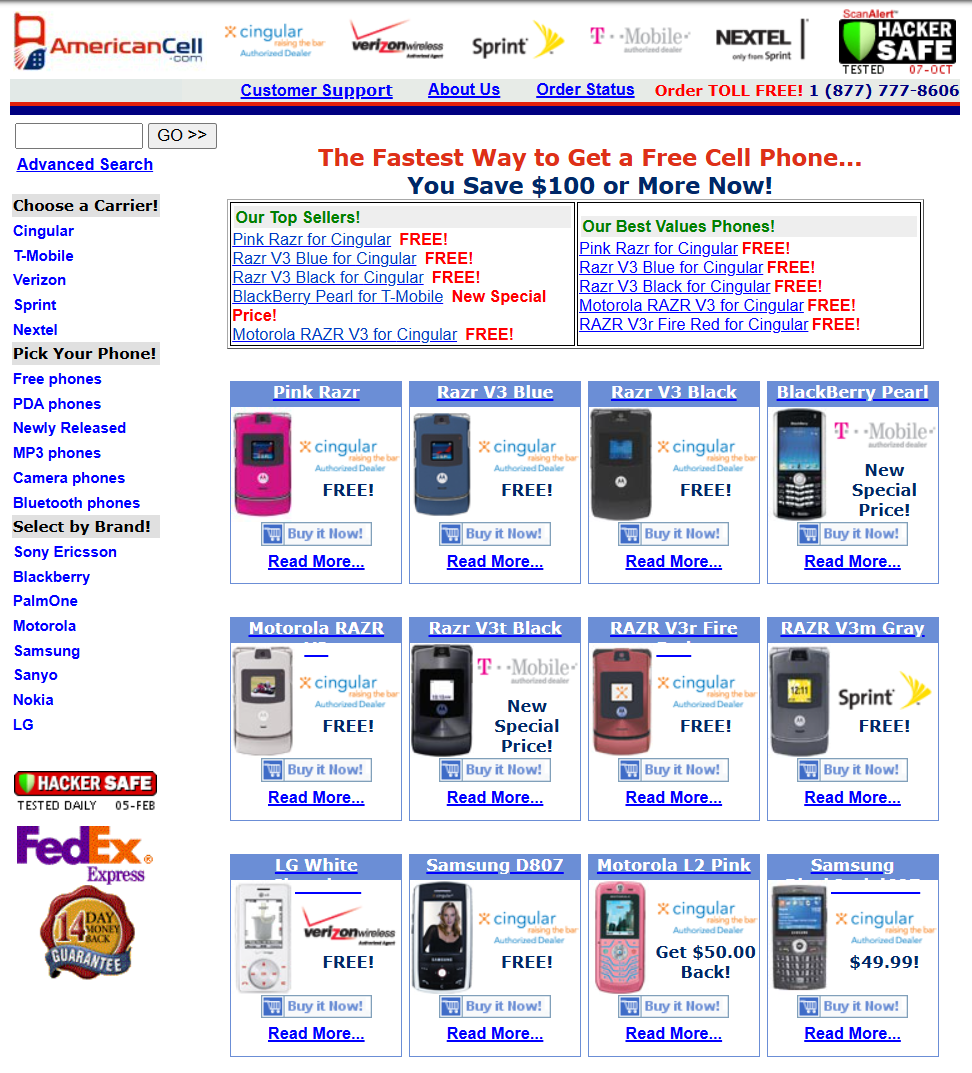
In the fall of 2006, RIM was about to launch the BlackBerry Pearl, and we put a promotion for it up on AmericanCell before the phone was even out. The words were right. The picture was not. A junior writer on our team had used a photo of Samsung’s new BlackJack, a phone that looked almost exactly like the Pearl.
That turned out to be RIM’s whole point. In December 2006 RIM sued Samsung in federal court in California, saying the BlackJack name was too close to BlackBerry and would confuse buyers. The Globe and Mail opened its story on the lawsuit with our mix-up. When the paper reached me in Los Angeles, I had not even heard about the case. “I guess we fell into the trap,” I said. “We usually get it right.” You can read the full article here.
Our page was such a clean example of the confusion RIM was describing that we were almost subpoenaed to testify. We never had to. RIM and Samsung settled in February 2007.
2007: $10,000 for a cell phone call from the moon
In September 2007, Google and the X Prize Foundation announced the Google Lunar XPRIZE: $30 million for landing a private spacecraft on the moon. We figured landing was nice, but you should also be able to call home. So we added our own prize.
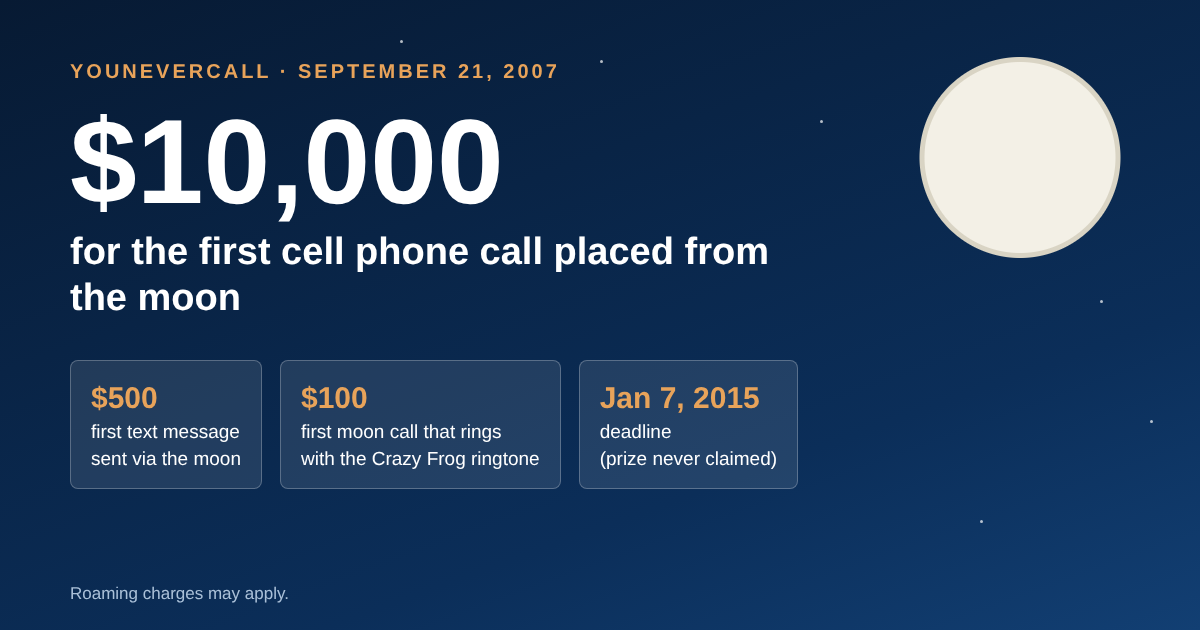
The rules: $10,000 to the first person or device to place a call from the surface of the moon, through a commercially available cell phone, to our Los Angeles phone number. The caller had to be able to answer a few yes or no questions. There was $500 for the first text message sent via the moon, and $100 for the first moon call that rang with the Crazy Frog ringtone. The deadline was January 7, 2015. We also reminded everyone that roaming charges may apply. You can read the full release here.
The coverage was everywhere. Gizmodo called it “a marketing scam, but a clever one” and humored us anyway. Engadget said it looked like “a bit of cheap PR.” Both were fair. It also ran in South Africa (Bizcommunity), Russia (Helpix) and Denmark (Mobilsiden).
Nobody ever claimed the prize. The Google Lunar XPRIZE ended in 2018 with no winner. Israel’s Beresheet got close in 2019 before crashing on landing. In March 2025, Nokia put the first cellular network on the moon aboard Intuitive Machines’ Athena lander. But the lander ended up on its side, did not have enough power, and the first cell phone call from the moon never happened. Our deadline had passed ten years earlier anyway. The $10,000 is safe.
2008: The Go Button
In June 2008 we released The Go Button, a free Windows app that found open WiFi networks and connected your laptop to one that actually worked. Back then, if you opened a laptop in a city you saw a long list of networks, and half the open ones would not let you online. The Go Button did the trial and error for you. Some people called it a WiFi stealer. We meant it for public networks. You can still find it on download sites today.
How a phone store became Five Blocks
Here is the part that mattered most. We sold a lot of phones. A few customers had complaints, which happens in any business. But those few complaints showed up at the top of Google when you searched our name. A handful of angry posts were doing more to define us than all of our happy customers.
So I started writing refund checks to make things right. Some of the people I paid turned out to be frauds. That was my crash course in how a company’s name looks online, who controls it, and how hard it is to fix. I got more interested in that problem than in selling phones. We moved into consulting, renamed the company Five Blocks, and today we help large companies and public figures with exactly that problem on Google, Wikipedia and now AI.
I told this story to Barry Schwartz of Search Engine Roundtable in 2023:
Why the site is still up
I keep YouNeverCall.com running for nostalgia. It is also where Five Blocks came from. A lot of what we now do for clients on Google, I learned first as a guy selling phones online, watching a few complaints outrank everything good we did.
The press clippings
- Color My Cell Phone for 2006, PRWeb, January 31, 2006
- Popular Online Cell Phone Store YouNeverCall Offers Virtual Cell Phones in Second Life, PRWeb, November 2006
- In-Game Cellphones for Second Life, TechCrunch, November 2006
- Second Life gets virtual cell phone, FierceWireless, November 2006
- Second Life Gets Cell Phone, Thought Garage, November 2006
- Second Life Game Gets Virtual Phones, InformationWeek, November 28, 2006
- Vodafone Goes Virtual, TechCrunch, January 22, 2007
- RIM Sues Samsung Over BlackJack Device, The Globe and Mail, December 2006 (reposted on Techgasm)
- Google Moon Prize Upped by YouNeverCall, full press release, September 21, 2007
- YouNeverCall Promises $10,000 to the First Cell Phone Caller from the Moon, Gizmodo, September 2007
- YouNeverCall offers cash for first cell call from the moon, Engadget, September 23, 2007
- YouNeverCall from the moon, Bizcommunity, September 2007
- Call us from the moon (in Russian), Helpix, September 2007
- Call from the moon and win money (in Danish), Mobilsiden, September 2007
- Vodafone InsideOut (in Spanish), Xataka Móvil, November 2007
- Second Lifers get real world phone lines, Telecoms.com, December 12, 2007
- Telco monopolies get Second Life, FierceWireless Europe, 2008
- YouNeverCall Announces Free Wifi WorldWide for Your Laptop, PRWeb, June 18, 2008
- Vlog #211: Sam Michelson and Client Business Development, Search Engine Roundtable, February 2023